


Battle-ready swords: Features, testing, and collector insights
Walk into almost any sword shop or scroll through any blade retailer online, and you’ll see “battle-ready” slapped on everything from wall-hanger display pieces to hand-forged carbon steel weapons. The problem? The term is completely unregulated. No governing body defines it. No universal certification exists. What one seller calls battle-ready, a seasoned martial artist might dismiss as decorative. For collectors and enthusiasts who care about true functionality, this ambiguity is more than an inconvenience. It’s a real risk. This guide cuts through the marketing noise and lays out the empirical criteria that actually separate functional swords from glorified props.
Table of Contents
- Unpacking the term: What does ‘battle-ready’ really mean?
- Empirical tests: How battle-ready swords are verified
- Materials and construction: What makes a sword truly battle-ready
- Application and collecting: Choosing and maintaining battle-ready swords
- Why collectors should demand proof, not labels
- Explore handcrafted battle-ready swords at Top Swords
- Frequently asked questions
Key Takeaways
| Point | Details |
|---|---|
| Battle-ready is contextual | There is no universal standard—ask for specs and empirical proof instead of trusting labels. |
| Empirical testing matters | Real battle-ready swords pass cutting and flex tests on standardized targets, proving actual function. |
| Materials define functionality | Carbon or spring steel with high hardness and robust construction are essential for reliability. |
| Collector diligence is critical | Smart buyers look for documentation, maintenance advice, and avoid ambiguous marketing claims. |
Unpacking the term: What does ‘battle-ready’ really mean?
The phrase “battle-ready” carries genuine historical weight. Historically, a sword fit for combat had to meet strict functional requirements: a blade tough enough to absorb repeated impact, an edge sharp enough to cut cleanly, and a handle secure enough to survive the stress of actual use. Warriors and armorers didn’t debate labels. They tested weapons under real conditions or trusted proven craftsmen.
Fast forward to modern times, and the term has splintered into several overlapping meanings depending on who’s using it.
In martial arts circles, battle-ready typically refers to swords appropriate for historical cutting tests, live cutting practice, or HEMA (Historical European Martial Arts) sparring. In this context, the sword must actually perform under controlled but realistic conditions.
In the collecting world, battle-ready often means the sword could be functional, as opposed to a purely decorative piece with a welded or blunt blade and inferior steel. It’s a quality indicator, not a certification.
In retail marketing, the term sometimes means very little. As sword enthusiasts frequently point out, “battle-ready” is unregulated and context matters greatly, which means a seller can apply it without meeting any objective standard.
“Battle-ready is a marketing term, not a technical specification. Always ask what steel, what hardness, and what tests were performed.”
This is the core problem for collectors. A label alone tells you almost nothing. Common misconceptions include:
- Stainless steel swords labeled battle-ready (stainless is brittle under lateral stress)
- Decorative swords with sharp edges sold as functional
- Replicas of fictional weapons, like a Sesshomaru battle sword, marketed as “ready” without specifying steel type or hardness
- Full-tang construction advertised as sufficient (tang design matters enormously, but width, thickness, and attachment method matter too)
The solution is simple but requires discipline: demand specifications, not just labels. A battle-ready medieval sword worth its price will come with documented steel type, hardness rating, and construction details. Anything less is marketing.
Empirical tests: How battle-ready swords are verified
Real functional swords are validated through performance, not packaging. The sword community has developed several reliable benchmarks that go far beyond a sharp edge.
Tameshigiri is the gold standard for cutting evaluation. Originating in feudal Japan, tameshigiri involves cutting through soaked tatami mats, which are rolled and soaked 12 to 24 hours to approximate the density of human muscle and bone. A sword that fails at this test, whether by deflecting, binding, or chipping, fails the most basic functional measure.
Bamboo cutting adds another layer. Practitioners use bamboo ranging from 12mm to 40mm in diameter, with thicker bamboo representing higher skill and blade demands. A sword that chips or deforms on green bamboo is not truly battle-ready.
HEMA flex tests apply a different kind of stress. In Historical European Martial Arts, training swords (called feders) must flex safely under load. A standard benchmark is 12 to 16 kilograms of force applied at 25 centimeters from the tip, with the blade flexing and returning true without permanent deformation.
Here’s a quick comparison of what each test measures:
| Test | Target material | What it reveals |
|---|---|---|
| Tameshigiri | Soaked tatami mat | Edge geometry, steel toughness |
| Bamboo cutting | Green bamboo (12-40mm) | Sharpness, blade flex, durability |
| HEMA flex test | Feder under 12-16kg load | Spring temper, resilience |
| Repeated impact | Wood, rattan targets | Handle integrity, tang strength |
A sword that passes all four categories has earned the functional label. One that passes only the visual inspection has not.
The numbers to know:
- Blade hardness should fall between HRC 48 and HRC 57 for most functional applications
- Tatami soaking time of at least 12 hours is required for a valid tameshigiri test
- A flex test load of under 12kg is too light to reveal poor tempering
- Bamboo diameter under 20mm is beginner-level; serious tests use 30mm or larger
Important stat: A blade that chips on soaked tatami has almost certainly been over-hardened, a common flaw in budget swords falsely labeled battle-ready.
Swords like the Damascus cutting sword or the Elja pattern sword are designed with these standards in mind, combining forge-welded layered steel with proper hardness profiles.
Materials and construction: What makes a sword truly battle-ready
Once you understand how swords are tested, the material requirements become obvious. Steel choice is the single biggest factor.
Carbon steel and spring steel are the preferred materials for functional blades. High-carbon steel (typically 1075, 1095, or 5160 spring steel) can be differentially heat-treated to achieve the right balance of hardness at the edge and flexibility at the spine. This is what allows a sword to hold an edge without snapping under impact.
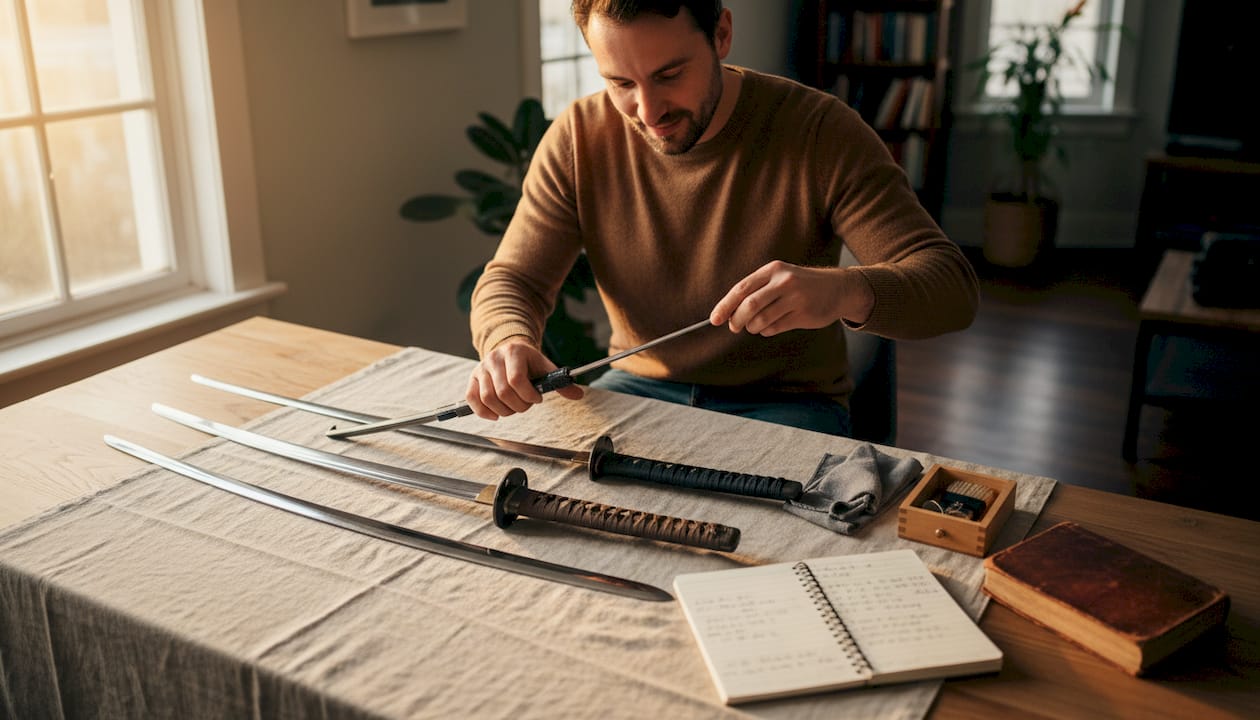
Stainless steel is a different story. While it looks attractive and resists surface rust, stainless steel is brittle and unsuitable for battle-ready swords because it lacks the toughness needed to absorb lateral stress. A stainless blade can shatter during a hard cut or block, creating a serious safety hazard. The stainless steel claymore and similar pieces are beautiful for display, but collectors must understand the functional limits of stainless.
For Damascus blade construction, the situation is nuanced. Pattern-welded Damascus steel can be highly functional when made from high-carbon layers, but decorative Damascus using low-carbon steel is not suitable for cutting use. Always confirm the base steel used in the weld.
Here’s a side-by-side comparison of the most common blade materials:
| Material | Hardness range | Functional use | Best for |
|---|---|---|---|
| 1075 high carbon | HRC 48-52 | Yes | Cutting, sparring |
| 5160 spring steel | HRC 50-54 | Yes | Heavy use, durability |
| 440C stainless | HRC 55-58 | No | Display only |
| Pattern-welded Damascus | Varies | Depends on base steel | Collecting, cutting |
Construction details matter just as much as steel choice. The tang, which is the part of the blade that extends into the handle, must run the full length of the grip (full tang) and should be thick and wide enough to resist twisting. Peened or pinned tangs are the most secure. Handles should use hardwood, bone, or wrapped cord, secured with rivets or epoxy-and-pin combinations.
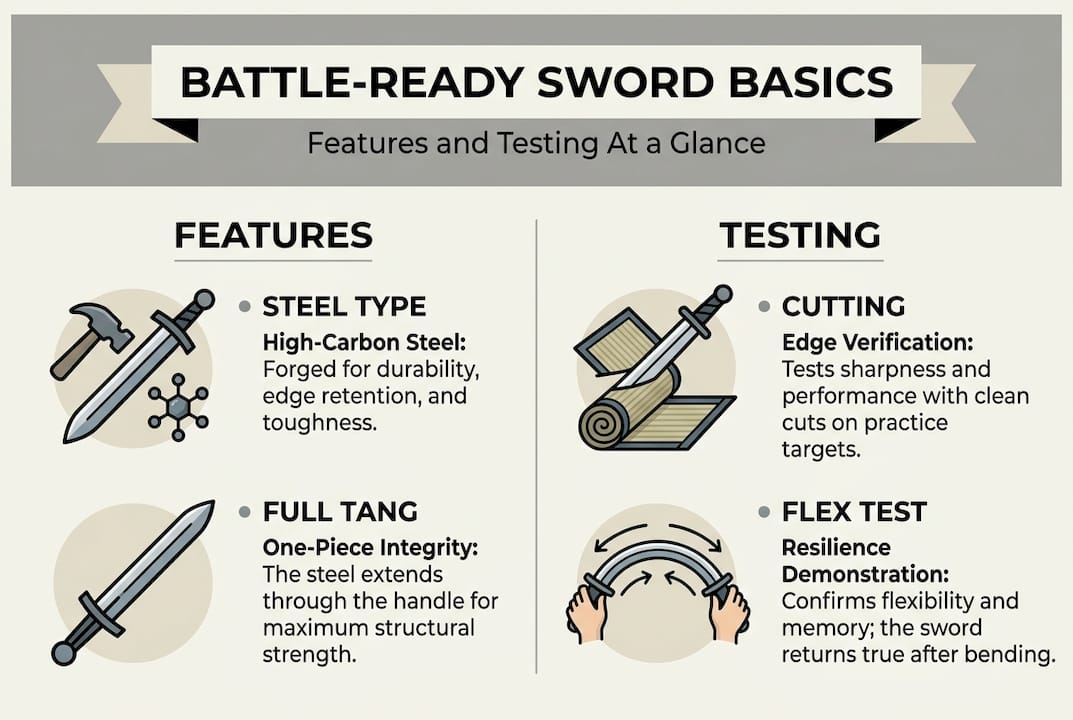
Pro Tip: Before buying any sword described as battle-ready, check the battle-ready sword features listed by the seller. A legitimate functional sword will specify steel type, HRC hardness, tang design, and edge geometry. If those details are missing, treat the blade as decorative.
Key construction checklist for battle-ready swords:
- Full tang with peened or pinned pommel
- High-carbon or spring steel (1075, 1095, or 5160)
- HRC hardness of 48 to 57
- Appropriate edge grind for intended use (sharp for cutting, blunted for sparring)
- Regular maintenance: light oil application every 1 to 3 months and inspection for handle play
For collectors exploring material alternatives, there are several reliable steel grades worth researching before committing to a purchase.
Application and collecting: Choosing and maintaining battle-ready swords
Owning a functional sword is a commitment, not just a purchase. Getting the most out of it means choosing smart and maintaining consistently.
Buying tips for collectors:
- Ask for steel specification before clicking buy
- Check for independent user reviews that mention cutting performance, not just appearance
- Request test videos or look for them in the product listing
- Compare the price against known functional sword ranges; under $100 is almost always decorative regardless of label
- Confirm whether the sword is intended for cutting, sparring, or display
For enthusiasts who want a visually striking blade that also functions, a Kirito replica sword designed with proper steel and construction can deliver both aesthetics and real performance.
Safe handling is non-negotiable. Sharp swords require a firm, confident grip, a secure scabbard, and clear space around you during handling. Blunted sparring swords still require protective gear including gloves, mask, and jacket. Never treat any sword as inherently safe because it’s labeled a replica or collectible.
Routine maintenance separates a sword that lasts decades from one that degrades within a year. Oil carbon steel regularly to prevent rust, especially in humid climates. Even a thin film of camellia oil or mineral oil applied monthly is enough to protect the blade.
Pro Tip: Store swords horizontally or blade-down in a dry environment. Storing blade-up in a scabbard traps moisture against the edge and accelerates corrosion.
Common collector mistakes:
- Leaving fingerprints on bare carbon steel (skin oils accelerate rust)
- Storing swords in foam-lined cases without moisture control
- Ignoring handle play until the grip loosens completely
- Misreading a “battle-ready” label as an endorsement for cutting practice without verifying the steel
Document provenance from day one. Keep receipts, photos, and any test records that come with the blade. This matters for resale value and for verifying authenticity if the sword changes hands.
Why collectors should demand proof, not labels
Here’s the uncomfortable truth most sword retailers won’t tell you: the majority of “battle-ready” claims are marketing decisions, not engineering ones. We’ve seen beautiful swords from reputable-looking brands fail basic tameshigiri tests because the steel was over-hardened or the heat treatment was inconsistent. The label meant nothing.
Experienced collectors in the sword community are clear: no universal standard exists, and you must evaluate by specs, not by label. This isn’t cynicism. It’s the practical reality of an unregulated market.
The collectors we respect most don’t ask “is it battle-ready?” They ask for the steel grade, the hardness certificate, the tempering method, and the tang dimensions. They check community forums for real-world test results. They watch video reviews showing actual cutting, not just aesthetics.
A Damascus steel sword with documented high-carbon layers and a published HRC rating is worth far more confidence than a vague “battle-ready” badge. Trust the specs. Demand the proof. Your investment and your safety depend on it.
Explore handcrafted battle-ready swords at Top Swords
Knowing what separates a truly functional sword from a decorated wall piece makes it much easier to shop with confidence. At Top Swords, we curate handcrafted blades with published specifications so you know exactly what you’re getting before you buy.

Browse options like the Damascus battle sword with leather sheath, the double edge short sword, or the historical replica sword, each built with forge-welded Damascus steel and detailed craftsmanship. Whether you’re adding to your collection or looking for a functional cutter, Top Swords offers transparency in steel, construction, and purpose. No vague labels. Just honest craftsmanship.
Frequently asked questions
Is there an official standard for ‘battle-ready’ swords?
No, “battle-ready” is unregulated and carries no universal meaning; collectors should rely on empirical specifications and real-world performance data instead of the label alone.
How can I tell if a sword is truly battle-ready?
Check the blade material, hardness (HRC rating), tang construction, and ask for cutting or flex test results; swords tested through tameshigiri on soaked tatami have met one of the most trusted functional benchmarks.
Are stainless steel swords battle-ready?
Generally no. Stainless steel is brittle under lateral stress and can shatter during hard use; carbon or spring steel with proper heat treatment is the correct choice for functional swords.
Can I use a battle-ready sword for martial arts training?
You can, but many martial arts require blunted, rounded blades for safety; HEMA uses blunted swords specifically to allow controlled sparring without the injury risk of a live edge.
What maintenance is required for a battle-ready sword?
Regular oiling is critical: oil carbon steel monthly to prevent rust, store in a dry environment, and inspect the handle and tang for any looseness or wear after use.