


How swords are made: techniques and craftsmanship
Most people assume a sword is just sharpened metal. Heat it, bang it, done. That picture misses about 3,000 years of metallurgical refinement. The truth is that swordsmithing sits at the intersection of ancient ritual and hard science, where the choice of steel, the number of folds, and the exact temperature of a quench tank can mean the difference between a museum-worthy blade and a piece of scrap metal. Whether you collect for display, cosplay on weekends, or simply respect the craft, understanding how swords are actually made changes the way you see every blade you own.
Table of Contents
- Understanding the fundamentals: Materials and methods
- Art of forging: Traditional Japanese and European swordsmithing
- Modern swordmaking: Technology meets tradition
- Heat treatment and finishing: The science behind the edge
- The truth most collectors miss: Sword value beyond the steel
- Custom swords for your passion
- Frequently asked questions
Key Takeaways
| Point | Details |
|---|---|
| Two main methods | Sword making uses forging and stock removal, each with unique advantages. |
| Cultural techniques matter | Japanese and European traditions have distinct forging, folding, and finishing processes. |
| Modern meets classic | Today’s swordsmiths blend historical artistry with advanced technology for varied results. |
| Heat treatment is essential | Proper heat handling gives a sword its strength, flexibility, and lasting value. |
Understanding the fundamentals: Materials and methods
Not all swords are created the same, and the first place that gap shows up is in the materials and the method used to shape them. Primary sword making techniques are forging and stock removal, two very different roads to the same destination.
Forging means heating metal to a plastic state and hammering it into shape using an anvil and hammer. It compresses the grain structure of the steel, building density and strength over time. Stock removal, by contrast, starts with a bar of steel and grinds away everything that isn’t a sword, using precision tools to achieve a refined profile. Both are legitimate, and both produce excellent blades depending on the application.
The choice of raw material matters just as much. High-carbon steel (typically 1045 to 1095 on the carbon scale) is the modern standard for modern sword manufacturing because it balances hardness and toughness. Tamahagane, the traditional Japanese steel made from iron sand and charcoal, carries a complex mix of carbon percentages that skilled smiths must sort and work by eye. Modern powder steels, produced by atomizing molten metal into fine particles, offer near-perfect grain uniformity.
| Feature | Traditional forging | Stock removal |
|---|---|---|
| Primary tool | Hammer and anvil | Belt grinder or CNC machine |
| Timescale | Days to weeks | Hours to days |
| Grain structure | Compressed and refined | Unchanged from bar stock |
| Best outcome | Layered, organic blade character | Clean, consistent geometry |
| Skill barrier | Very high | Moderate |
Here are a few key terms every enthusiast should know:
- Anvil: The heavy steel block against which the smith strikes heated metal
- Fuller: A groove ground or hammered into the blade to reduce weight
- Quench: Rapid cooling of hot steel in water, oil, or brine to harden it
- Temper: A follow-up heat cycle that reduces brittleness after quenching
- Martensite: The hard, crystalline structure steel forms after rapid quenching
Folding steel during forging is one of the craft’s most misunderstood details. Folding steel 8 to 16 times can yield up to 65,536 microscopic layers, redistributing carbon and purging slag for a cleaner, tougher blade.
Pro Tip: Folding beyond 16 to 20 times actually homogenizes the steel too much, erasing the carbon variation that gives the blade its character and reducing its overall strength rather than improving it. Explore how Damascus steel battle swords use controlled layering to achieve stunning visual patterns alongside real performance.
Art of forging: Traditional Japanese and European swordsmithing
With materials and methods mapped out, the next step is watching those principles come alive in the hands of a master smith. Traditional Japanese katana forging uses tamahagane steel from a tatara furnace, a clay-walled smelter fed with charcoal and iron sand over several days.
Here is how a katana takes shape, step by step:
- Tatara smelting: Iron sand and charcoal burn for 72 hours, producing a bloom of tamahagane. Only about one-third of the bloom is usable after the smith sorts pieces by carbon content.
- Breaking and sorting: The bloom is broken apart so the smith can select high-carbon and low-carbon sections, which will become the hard edge and softer spine respectively.
- Folding: Selected steel is heated and hammered flat, then folded repeatedly to distribute carbon and remove impurities.
- Shaping: The smith hammers the billet into the sword’s rough profile, forming the curvature that defines the katana’s silhouette.
- Clay coating: A clay mixture called tsuchioki is applied before the final quench, thicker on the spine and thinner on the edge, creating differential hardness.
- Quenching: The coated blade is heated and plunged into water, locking in the characteristic hamon (temper line) visible on every authentic katana.
“Folding steel creates layers, but folding beyond 16 to 20 times homogenizes the steel, eliminating any real benefit and potentially weakening the blade. The magic is in precision, not repetition.”
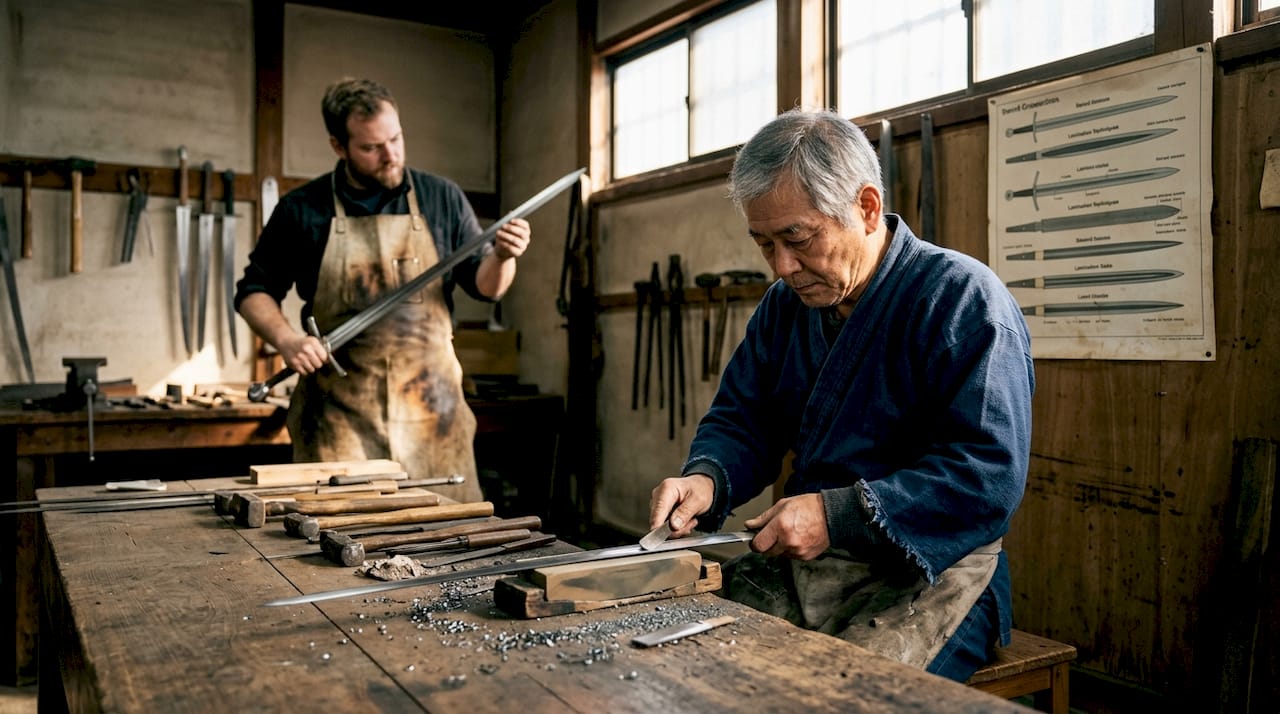
European smiths took a different path. Rather than differential hardening, they pursued full-length quenches and later relied on cross-guards and pommel geometry for balance. Here is how the two traditions compare:
| Feature | Japanese katana | European longsword |
|---|---|---|
| Steel type | Tamahagane (variable carbon) | Wrought iron + high-carbon steel |
| Folding practice | 8 to 16 times, sorted layers | Minimal folding, pattern welding in some |
| Quenching method | Water quench with clay coating | Full oil or water quench |
| Edge hardness | Selectively hard edge, softer spine | More uniform hardness throughout |
| Characteristic finish | Visible hamon temper line | Polished, uncoated or blued |
For collectors interested in authentic katana making, understanding these steps makes the difference between recognizing a genuine piece and falling for a decorative imitation.
Modern swordmaking: Technology meets tradition
Ancient smiths refined their art through generations of trial and painful error. Today’s makers don’t have to start from scratch, and that creates both advantages and trade-offs worth knowing.
Contemporary sword production often uses powder metallurgy, a process where steel is atomized into fine particles and sintered (fused under heat and pressure) into a billet with near-perfect grain consistency. CNC grinding replaces hours of hand grinding with computer-controlled precision. Laser cutting handles guard and fitting geometry that once required a specialist file-worker. Hybrid finishing combines machine-ground bevels with hand-polished flats for efficiency without sacrificing visual quality.
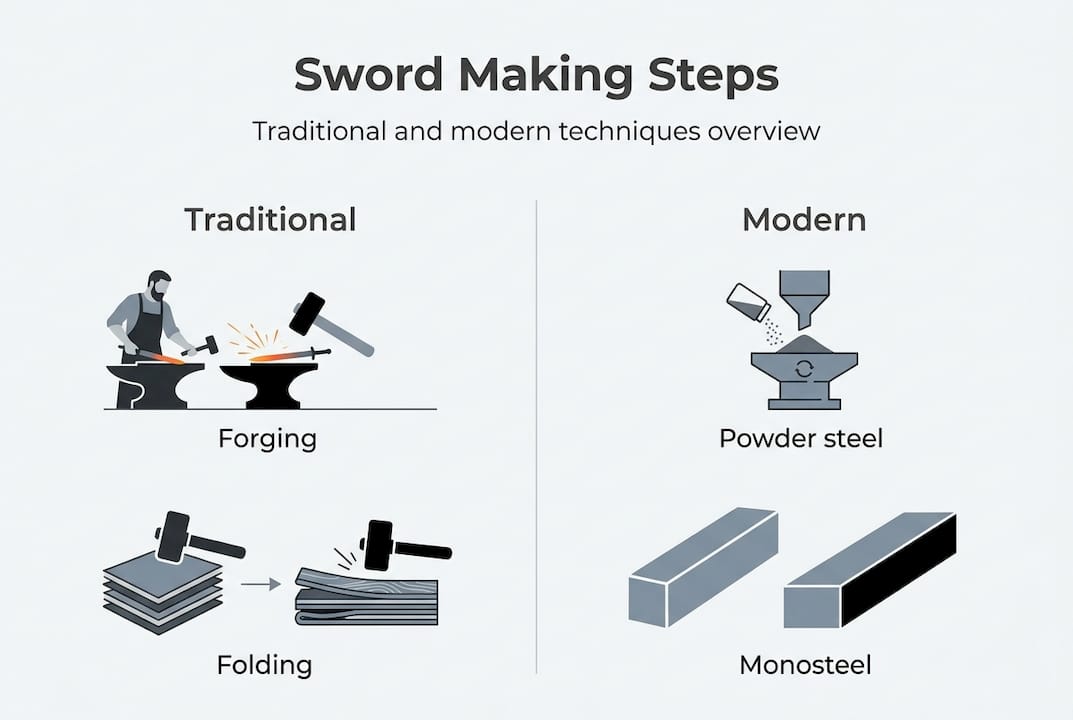
Modern powder steels offer superior uniformity and toughness compared to traditional tamahagane, but they lack the cultural layering and visual story that collectors value in handmade pieces.
Here are the three main modern sword types and where they shine:
- Monolithic high-carbon or tool-steel blades: Ground from a single bar with no lamination. Extremely consistent performance and the go-to choice for functional martial arts swords.
- Laminated composite blades: Hard steel edge welded to a tougher spine, mimicking traditional construction with modern materials. Great for practitioners who want history with reliability.
- Damascus pattern-welded blades: Two or more alloys forge-welded and manipulated to create surface patterns. Valued as much for visual art as for cutting performance. These Damascus steel techniques represent the clearest bridge between old craft and new capability.
Traditional methods prioritize layered composites for a hard edge over a soft spine, while modern approaches favor monolithic high-performance steels for consistency.
Pro Tip: When assessing a collector’s sword, look for clear forge scale patterns, a visible hamon, or a hand-polished finish rather than a machine-buffed chrome sheen. These details reveal whether a maker invested real craft time or took shortcuts.
Heat treatment and finishing: The science behind the edge
A beautifully shaped blade is still just raw potential until heat treatment gives it character. This is the stage where metallurgy becomes almost alchemical.
Heat treatment for swords involves normalizing, quenching, and tempering in a precise sequence:
- Normalizing: The blade is heated to critical temperature and allowed to air cool, two or three times. This relieves internal stress from forging and creates an even grain structure before hardening.
- Quenching: The blade is brought back to critical temperature and plunged into oil, water, or brine. Rapid cooling transforms the steel’s structure into martensite, an extremely hard but brittle phase.
- Tempering: The hardened blade is reheated to around 200°C (approximately 400°F) and held there, then cooled slowly. This releases some hardness in exchange for crucial toughness and flexibility.
Miss any stage, or get the temperature wrong by even 20 degrees, and the blade can warp, crack, or shatter under stress.
Finishing is where a sword stops being a functional object and becomes something worth displaying. Common finishing approaches include:
- Hand polishing: Progressive grits from 120 up to 2000 or higher, bringing out the steel’s natural grain and, in Japanese swords, revealing the hamon in striking detail
- Acid etching: Applied to Damascus or pattern-welded blades to bring out the contrasting layers in dark relief
- Fuller grinding: The groove running along the flat of many European blades
“The fuller reduces blade weight without sacrificing structural integrity, functioning like the I-beam geometry used in modern architecture.”
For collectors, the finish signals intent. A mirror-polished blade signals display priority. A working finish with visible hand-polishing marks and a muted hamon tells you someone built this to use. Check out examples of blade grinding and assembly to see how finishing choices shape the final character of a sword.
The truth most collectors miss: Sword value beyond the steel
Here is an angle that gets left out of most swordmaking breakdowns. The assumption is that better steel plus better technique equals more valuable sword. That formula works in engineering. It doesn’t always work in collecting.
We have seen collectors pay multiples more for a blade with documented provenance, a named smith’s signature, or a compelling cultural story than for a technically superior modern piece with flawless geometry. The narrative around the object shifts its perceived value completely. A hand-forged katana with an imperfect hamon and a traceable lineage will outperform a CNC-perfect monolithic blade at auction almost every time.
What makes a katana valuable isn’t always measurable in Rockwell hardness or edge retention tests. It’s the intersection of technical skill, cultural context, and the story of human hands working against fire and metal to create something meaningful.
“A sword is more than its edge. It is a canvas of human heritage.”
For cosplayers, the same logic applies differently. Authenticity of appearance and the emotional resonance of a blade’s design often matter far more than heat treatment details. Know what you value, and buy accordingly.
Custom swords for your passion
Ready to see the art and technology of swordmaking in your hands? Understanding how these blades are built makes holding one feel completely different. Every grind mark, every layer in the steel, every polished edge tells a story that now makes sense to you.

At TopSwords, we carry pieces that reflect the full range of swordmaking traditions, from custom Damascus battle swords built for serious collectors to historical replica swords that honor specific cultural traditions. Whether you’re building a display collection, gearing up for cosplay, or searching for a meaningful gift, the Top Swords collection gives you real craft at every price point.
Frequently asked questions
What is the difference between forging and stock removal in sword making?
Forging shapes heated metal with hammer and anvil, while stock removal grinds a blade from a larger steel bar using abrasive or cutting tools. Both produce quality swords, but forging compresses grain structure in ways grinding cannot replicate.
How many times is katana steel folded and why?
Katana steel is folded 8 to 16 times to purify the metal and evenly distribute carbon throughout the billet, resulting in a blade that is both tough and flexible. Folding beyond that threshold offers no real benefit.
What does the heat treatment process do for a sword?
Heat treatment normalizes, quenches, and tempers the blade, first hardening it through rapid cooling and then reducing brittleness through controlled reheating. The result is a blade that holds an edge without snapping under stress.
Are modern swords better than traditional ones?
Modern powder steels outperform traditional steels in lab benchmarks for uniformity and toughness, but traditional blades are revered for their artistry, cultural significance, and the irreplaceable craft behind each piece.