


How to build a sword collection: steps for collectors
Few hobbies reward patience and knowledge the way sword collecting does. A truly impressive display wall doesn’t happen by chance — it reflects years of research, deliberate choices, and an eye trained to separate genuine craftsmanship from mass-produced imitations. Whether you’re drawn to medieval European longswords, ornate Japanese katanas, or fantasy replicas straight out of your favorite game, building a meaningful collection means understanding the story behind each blade. This guide walks you through every stage of that journey, from laying your knowledge foundation to sourcing, acquiring, and preserving pieces that will hold their beauty and value for decades.
Table of Contents
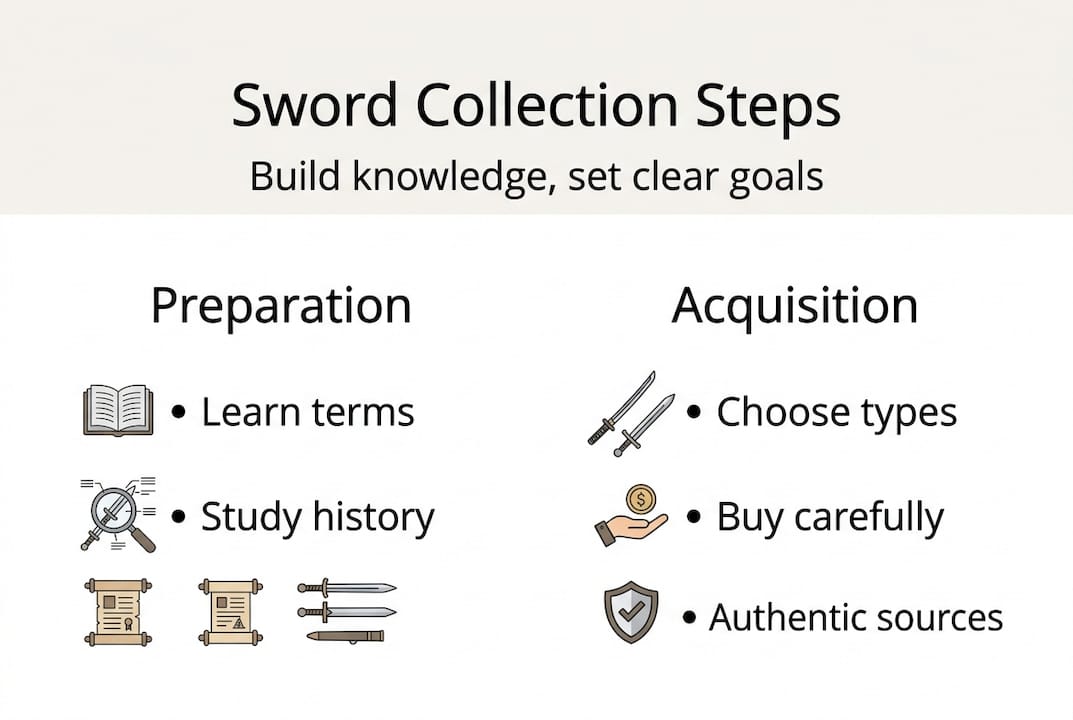
- Build your knowledge base
- Set your focus and goals
- Source and acquire your swords
- Care, display, and preserve your collection
- Why a true sword collection is more than the sum of its parts
- Ready to grow your sword collection?
- Frequently asked questions
Key Takeaways
| Point | Details |
|---|---|
| Research is key | Understanding sword types, history, and terminology prevents rookie collector mistakes. |
| Set clear collection goals | Decide your focus and budget to curate a more meaningful, valuable collection. |
| Source wisely | Use trusted channels and authentication practices to find and buy quality swords. |
| Preserve your investment | Proper care, UV-free display, and handling extend the life and value of your swords. |
| Collections tell stories | Thoughtful curation and documentation create a legacy that goes beyond the objects themselves. |
Build your knowledge base
Now that you have a vision for your collection, the first step is investing in your knowledge. Every seasoned collector will tell you the same thing: buying before you understand what you’re buying is the fastest way to waste money and fill your display with pieces you’ll eventually regret. The sword world is enormous, spanning thousands of years of human history across dozens of cultures, and that scale can feel overwhelming at first. Break it down systematically, and you’ll gain confidence quickly.
Start with education on sword types, history, and terminology to build a solid foundational knowledge before you spend a single dollar. A collector who understands the difference between a falchion and a sabre, or who can explain why a blade’s tang construction matters for both function and authenticity, will always make smarter purchases than someone shopping by looks alone. Understanding why people collect swords — whether for fandom, historical connection, or investment — also helps you clarify your own motivations early.
Key sword collecting categories
The most common categories you’ll encounter include:
- Historical swords: Functional or display pieces modeled after real weapons from specific time periods, such as Viking age, feudal Japan, or Renaissance Europe
- Fantasy and gaming replicas: Swords inspired by movies, books, and video games, often featuring dramatic proportions and ornate detailing
- Cosplay swords: Lightweight reproductions designed for costume wear, often made from aluminum or polypropylene rather than steel
- Modern artisan pieces: Custom or limited-run swords created by contemporary bladesmiths, often using high-carbon steel or Damascus patterns
- Antique originals: Genuine historical weapons, which require special knowledge and authentication skills
Common sword terms you should know
Before diving into purchases, get comfortable with terms like fuller (the groove running down a blade that reduces weight), quillon (the crossguard), pommel (the counterweight at the base of the handle), tang (the part of the blade that extends into the handle), and temper line (visible on Japanese blades, showing the hardening boundary). These aren’t just vocabulary — they’re the tools you use to evaluate quality and spot fakes.
Sword types comparison
| Type | Primary use | Typical materials | Price range |
|---|---|---|---|
| Historical replica | Display, collection | High-carbon steel | $80–$800+ |
| Fantasy replica | Display, cosplay | Stainless or carbon steel | $50–$500 |
| Cosplay sword | Costume wear | Aluminum, polypropylene | $20–$150 |
| Antique original | Investment, collection | Varies (original materials) | $500–$50,000+ |
| Artisan Damascus | Display, gift | Damascus, carbon steel | $200–$2,000+ |
Exploring the wide range of types of swords available will help you identify which categories resonate most with your collecting goals. You can also study understanding collector knives to see how the parallel world of knife collecting applies similar principles of provenance, craftsmanship, and condition evaluation. Looking at knight sword examples gives you a concrete sense of what quality craftsmanship looks like at the detail level.
Pro Tip: Before making your first purchase, identify three specific knowledge gaps you want to close — such as understanding blade steel grades, learning how to spot reproductions, or mastering one historical period — and fill those gaps through books, forums, and museum visits. Targeted learning beats random browsing every time.
Set your focus and goals
Deepening your knowledge helps you move to the next critical stage — setting your personal vision and goals. Without a clear focus, even a well-intentioned collection can become a random assortment of blades that lacks narrative, coherence, or real value. The best collections tell a story, and you’re the author.
Define your collecting objective
Start by answering four core questions honestly:
- What draws you to swords? Is it historical accuracy, artistic beauty, pop culture connections, or investment potential? Your answer shapes every decision that follows.
- How much space do you have? A 600-square-foot apartment calls for a very different collection strategy than a home with a dedicated display room.
- What is your realistic annual budget? Factor in not just purchase prices, but shipping, custom stands, maintenance supplies, and insurance.
- Are you collecting for display, for events, or for future resale? Each path has different priorities around condition, rarity, and documentation.
What sword collecting really costs
Sword collecting can begin modestly or scale dramatically. Entry-level historical replicas and cosplay pieces often range from $50 to $300, making this an accessible hobby from the start. Mid-range artisan work, including authentic replica options like handmade Damascus steel swords with historical inspiration, typically falls between $300 and $1,200. Serious collectors pursuing genuine antiques or rare auction pieces enter a very different financial territory.
Auction price benchmarks
Recent market data shows how high the ceiling can go. Edged weapons collections have sold for over $900,000 at auction, while individual medieval swords regularly fetch between €9,000 and €13,000 at European auction houses. Military pattern swords from the 19th century range from £200 to £5,000 depending on condition and provenance.
| Category | Typical auction range | Key value drivers |
|---|---|---|
| Medieval longsword | €9,000–€13,000 | Age, condition, provenance |
| Military pattern sword | £200–£5,000 | Regiment markings, maker stamps |
| Japanese katana (antique) | $5,000–$100,000+ | School, smith, documentation |
| Fantasy/movie prop | $500–$25,000+ | Screen use, signatures, rarity |
| Damascus artisan piece | $400–$3,000 | Smith reputation, pattern quality |
The appreciation potential is real, especially for pieces with documented history. Understanding Damascus steel appreciation in adjacent collector markets shows how material quality and craftsmanship directly influence long-term value. Reviewing motivations for collecting can also help you align your goals with your passion more precisely.
Pro Tip: If budget is a constraint early on, focus your limited funds on fewer, higher-quality pieces rather than accumulating many cheap ones. A single well-documented, well-crafted sword will give you more satisfaction and hold more value than ten generic replicas.
Source and acquire your swords
With your vision set, it’s time to start searching for swords to add to your collection. This stage requires both strategy and caution. The sword market includes incredible genuine pieces and an unfortunately large number of counterfeits, misleading descriptions, and outright scams targeting new collectors.
Where to find swords
Safe buying channels include:
- Reputable online retailers: Established stores with clear provenance descriptions, material specifications, and return policies
- Auction houses: Christie’s, Rock Island Auction, and Morphy’s regularly offer authenticated historical pieces
- Sword conventions and collector shows: Allow you to handle pieces in person and meet makers directly
- Private sellers through collector communities: Forums and clubs often produce trustworthy peer-to-peer transactions
- Direct from bladesmiths: Buying directly from artisans gives you full provenance from the start
Steps for buying swords online safely
- Research the seller’s history, reviews, and return policy before any contact
- Request full photographic documentation of the blade, handle, tang, and any markings
- Ask for material specifications in writing, including steel type, heat treatment, and finish
- Verify any historical or provenance claims through independent sources
- Use secure payment methods that offer buyer protection
- Inspect the piece immediately upon arrival against all descriptions
- Document your purchase with photographs, receipts, and any included certificates
Warning: Counterfeit swords are a real problem in the online marketplace. Suspiciously low prices on supposedly high-carbon or Damascus steel pieces, vague material descriptions, and no-return policies are red flags. If a deal looks too good to be true, it almost certainly is. Protect yourself by buying from sellers who can answer detailed questions confidently and specifically.
For collectors interested in historical accuracy, Roman replica swords offer a great starting point with clear cultural and historical reference points. Similarly, military replica swords from specific conflicts give collectors a focused niche with a rich body of research to draw from.
Legal considerations are also part of sourcing. Sword shipping laws vary significantly by country and even by state. Some jurisdictions restrict blade length, others regulate replica weapons differently from functional blades, and customs rules affect import from overseas manufacturers. Always research the specific laws for your location before ordering internationally.
Education on sword terminology also helps at the purchasing stage — a buyer who can ask the right technical questions immediately earns more credibility with serious sellers and is less likely to be misled.
Care, display, and preserve your collection
Once your first swords are in hand, care and display will determine their long-term beauty and value. Many collectors invest significant money in acquiring pieces, then undermine that investment through poor storage and handling. The good news is that proper care is straightforward once you establish the right habits.

Maintenance essentials
Regular maintenance including oiling, humidity control at 40 to 50 percent, UV-free storage and display conditions, cotton glove handling, and periodic rust inspection forms the backbone of any serious care routine. Carbon steel, which is the preferred material for high-quality historical replicas and artisan pieces, oxidizes readily without consistent attention. Even a fingerprint left on an unprotected blade can begin the corrosion process within days.
Essential care checklist
- Mineral oil or camellia oil: Apply a light coat every 1 to 3 months depending on climate and handling frequency
- Cotton gloves: Wear these every time you handle a blade to prevent skin oils from contacting the steel
- Microfiber cloths: For gentle cleaning without scratching the finish
- Humidity controls: A dehumidifier or humidity packs in your display space to maintain the 40 to 50 percent range
- UV-filtering display cases: Protects both blade and handle materials from light-induced degradation
- Silica gel packets: Useful inside scabbards and storage cases to absorb excess moisture
- Proper mounts: Wall mounts and stands should hold the sword securely without putting stress on the blade or crossguard
For displaying your swords, think carefully about light direction, viewer angle, and the security of your mounting hardware. A sword displayed horizontally on a wall requires a mount that distributes weight evenly across the blade without touching the edge. Vertical mounts tip-down reduce stress on the handle assembly. Understanding the basics of sword cleaning best practices also helps you understand why certain finishes and steel types need specific care approaches.
Beyond mechanics, display is also an aesthetic decision. Grouping swords by period, culture, or theme creates visual coherence and reinforces the collection’s narrative. Mixing framed historical prints, maps, or provenance documents alongside displayed blades adds depth that visitors immediately appreciate. If you’ve acquired pieces as gift-worthy sword care choices, include a small tag or document explaining the piece’s significance.
Pro Tip: Handle your swords with cotton gloves every single time, without exception. The oils on bare human hands are acidic enough to etch steel over time, leaving permanent fingerprint marks that are nearly impossible to polish out on finely finished blades. Make gloves part of your display ritual.
Why a true sword collection is more than the sum of its parts
Here’s something most guides won’t tell you directly: the swords themselves are only half the story. The collectors whose displays genuinely impress — and whose pieces hold the strongest long-term value — are the ones who treat their collection as a living document of knowledge, passion, and personal narrative.
A wall of swords without context is just inventory. A collection with documented provenance, thoughtful curation, and a clear thematic vision becomes something people remember. Each piece you acquire should connect to a broader story you’re telling, whether that’s tracing the evolution of European fighting swords, capturing the aesthetics of a beloved fantasy universe, or honoring a particular military tradition.
The collectors who find the most satisfaction are also the most active in their communities. Sharing knowledge, asking questions, and contributing to forums and clubs deepens your own expertise while building relationships that open doors to rare acquisitions and trusted sellers. Exploring collector passion and legacy shows how this community dimension shapes the most enduring collections. The best collections grow alongside their owners, and every sword added intentionally strengthens the whole.
Ready to grow your sword collection?
Building a meaningful sword collection is a long-term pursuit, and having access to high-quality, well-crafted pieces makes every stage of that journey more rewarding.

At TopSwords, you’ll find an expertly curated selection of handmade and display-ready swords spanning medieval European designs, historical replicas, fantasy pieces, and artisan Damascus steel creations. Whether you’re adding your first piece or hunting a standout centerpiece for an established display, the medieval sword selection offers exceptional craftsmanship with detailed descriptions to support informed decisions. Shop by category, discover limited-edition pieces, and find swords that reflect the level of quality your collection deserves.
Frequently asked questions
What is the best way to start a sword collection?
Begin by learning about sword types, history, and collecting basics before making any purchases. Knowledge built early prevents costly beginner mistakes and helps you recognize genuine quality when you see it.
How should I display swords safely at home?
Swords should be displayed in UV-free environments, away from humidity and direct handling, on secure mounts that support the blade’s full length without pressure points.
Are swords a good investment?
High-quality swords, especially rare or historical pieces, can appreciate significantly. Edged weapons collections have sold for over $900,000 at auction, demonstrating the serious financial ceiling for well-documented collections.
How do I prevent my swords from rusting?
Regularly oil your swords, always use cotton gloves during handling, maintain 40 to 50 percent ambient humidity, and keep blades away from UV light and moisture sources to prevent corrosion.