
VISIT OUR ONLINE SHOP
Available 24/7 via chat
Available 24/7 via chat
Available 24/7 via chat
Available 24/7 via chat

Two swords sit side by side. Same steel alloy, same blade length, same basic profile. One looks like a rippling pool of storm clouds frozen in metal. The other catches light in a crisp, defined line that traces the very boundary between hard and soft steel. That difference is not magic, and it is not just polish. It comes down to finish. Understanding blade finishes separates collectors who truly know their swords from those who just admire the shine.
| Point | Details |
|---|---|
| Finish reveals craftsmanship | The right sword finish highlights both the maker’s skill and the blade’s unique features. |
| Different finishes, different uses | Display, performance, and durability each call for specific types of sword finishes. |
| Authenticity matters | Real value lies in finishes that reflect true technique and historical accuracy. |
| Proper care required | Maintaining a sword’s finish preserves its beauty and performance for years to come. |
A sword finish is the final surface treatment applied to a blade after forging, grinding, and heat treatment. It shapes everything a collector sees, touches, and judges: color, texture, reflectivity, and even the story the blade tells about the hands that made it.
Finishes do more than create visual appeal. They can:
When you pick up a Damascus sword and see those flowing, layered patterns, you are seeing a finish at work. The acid etching has selectively attacked different steel compositions in the folded layers, making the pattern visible. Without the finish, that beauty would remain hidden.
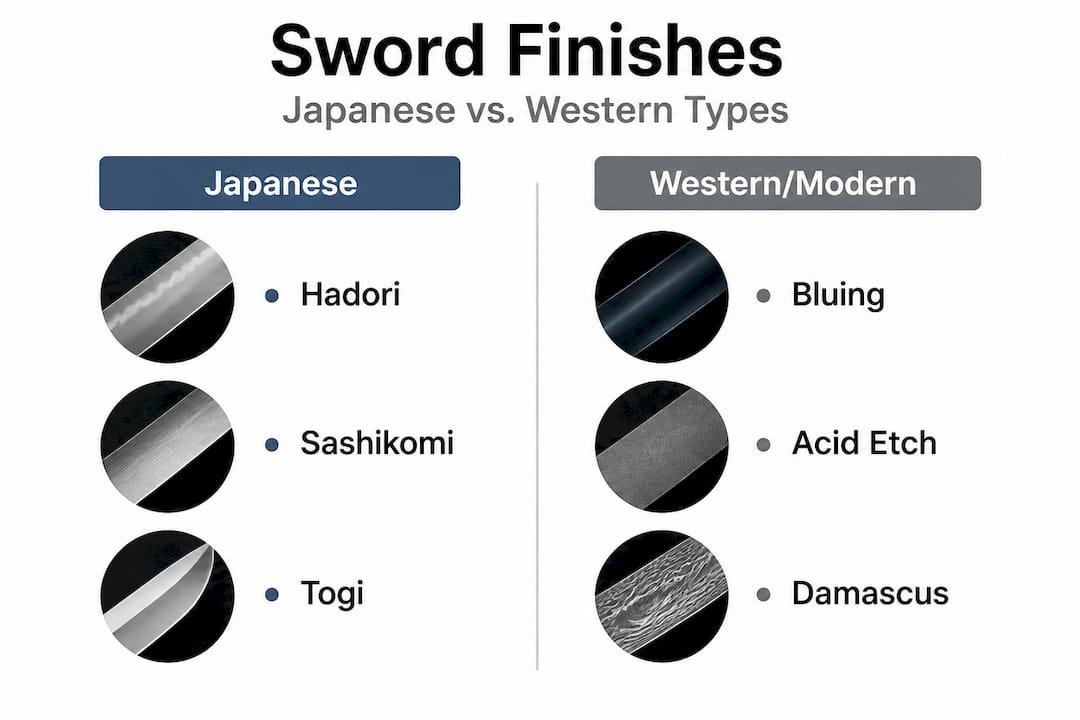
For collectors, a finish is often the most telling feature of authenticity. Historical accuracy and method matter as much as appearance. Japanese sword polishing, called togi, is a multi-stage process using natural stones like arato, nakato, shiage-to, hazuya, and jizuya to reveal both the hada and hamon. Each stage removes the marks of the previous one and introduces finer detail. A properly finished Japanese sword is essentially a window into the metallurgy inside.
Pro Tip: When evaluating a sword’s finish, look at it under both direct and raking (angled) light. Display pieces often reveal their best features from one specific angle, which tells you what the polisher intended you to see.
With the basics clarified, let’s explore the major types of sword finishes you’ll encounter.
Japanese swordsmithing has elevated blade finishing to a distinct art form. The polisher, called a togishi, can spend decades mastering techniques that most collectors never fully understand. These are not shortcuts. They are careful, deliberate methods with very different visual results.
Hadori is the most widely seen Japanese finish on modern display swords. Using a small fingertip stone called a hadori-to, the polisher lightens the area around the hamon against a mirror-polished background. The hadori finish uses a coarser stone to make the hamon stand out dramatically, creating a bold, bright contrast. This is a newer style, developed over roughly the past century, and it is ideal for collectors who display their swords under spotlights or in lit cases.
Sashikomi nugui is a far more refined and traditional approach. After completing the base polishing stages with hazuya and jizuya stones, the polisher applies nugui, a mixture of iron oxide, to the blade. This sashikomi nugui method darkens the jihada (the body of the blade) while whitening the hamon, preserving fine detail within the temper line itself. Unlike hadori, sashikomi reveals subtle activity within the hamon: structures called nie and nioi, tiny crystalline formations that only appear with this level of care.
Here is a direct comparison to help you choose what suits your collection:
| Finish type | Core process | Visual result | Best use case |
|---|---|---|---|
| Hadori | Fingertip stone lightens hamon area | Bold, bright hamon contrast | Display, lit cases, photography |
| Sashikomi nugui | Nugui applied after hazuya/jizuya | Nuanced contrast, fine hamon detail | Traditional collections, side-view appreciation |
| Classical togi (full polish) | All stone stages, no shortcuts | Maximum geometry, full hada visibility | Museum-grade pieces, high-value swords |
The classical togi process encompasses all stages and produces the most honest picture of the blade’s internal structure. Every flaw in the steel becomes visible. Every area of excellent activity in the hamon comes to life. It is the most demanding finish to produce and the most rewarding to study.
Pro Tip: Sashikomi nugui polishes are best appreciated in diffuse, natural light. If you only ever look at your sword under a direct spotlight, you are missing everything that makes this finish special. Move it to a window on an overcast day and watch the blade transform.
Understanding Japanese finishes lays a foundation; now, let’s examine Western and modern finishes.
European and Middle Eastern blade traditions developed their own finishing methods, shaped by different steels, different functions, and different aesthetic goals. Today, these techniques are also used on contemporary collector swords, sometimes authentically and sometimes superficially.
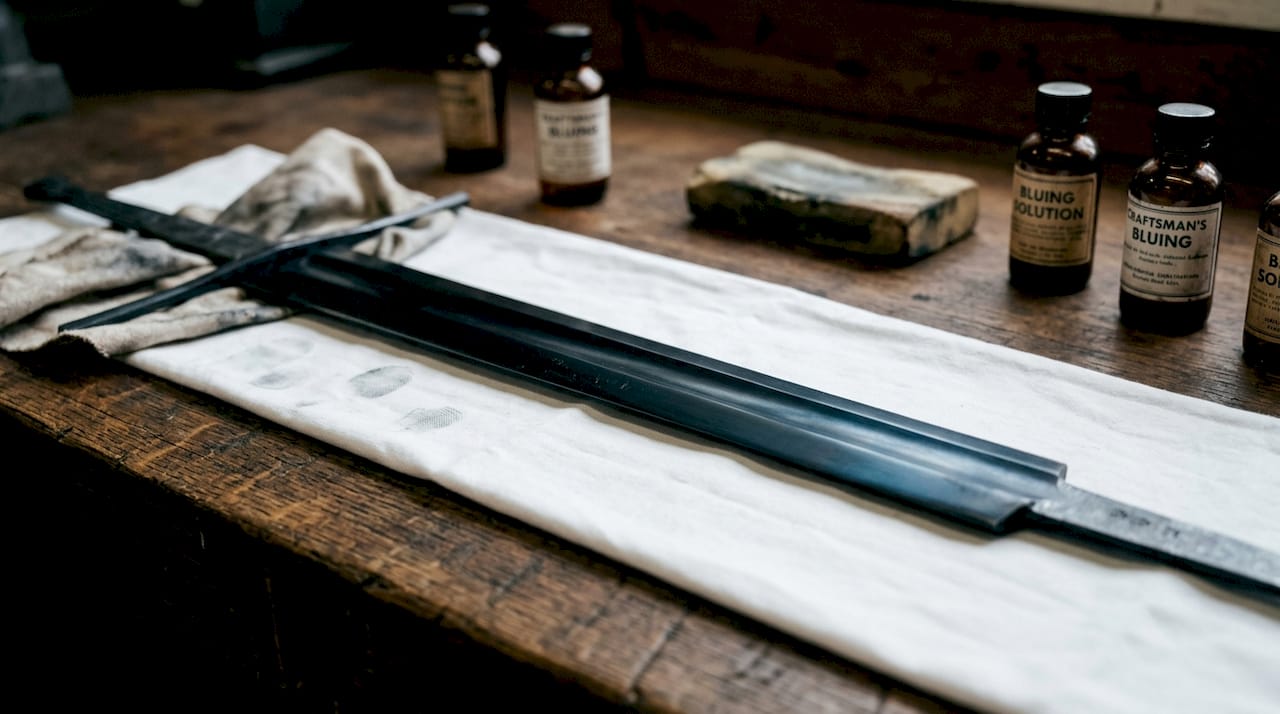
Bluing is one of the most historically significant Western finishes. A
Acid etching is the primary method used to reveal patterns in Damascus and pattern-welded steel. The process works because the different steel compositions in folded or layered blades react differently to acid. High-carbon layers darken faster, low-carbon layers stay brighter, and the contrast between them maps out the weld lines and folding patterns. On a handmade Damascus scimitar or a piece like the Brute Elja pattern sword, acid etching does not create the pattern. It reveals one that was built into the steel through hundreds or thousands of folds and welds.
This is a critical distinction. According to Damascus steel patterns and history, the flowing visuals you see in genuine layered steel come from structural differences inside the metal, not from surface treatment alone. A purely decorative acid pattern etched onto plain steel looks superficially similar but represents a fundamentally different object.
“Ask whether the pattern continues through the blade or only sits on the surface. Real Damascus patterns are structural. You can grind them, reshape them, and they are still there.”
Key facts collectors should know about Western and modern finishes:
The depth and layering visible in a well-etched Damascus blade reflects hours of careful work in both the forge and the finishing process. When collectors learn to distinguish real layering from surface pattern, their appreciation for authentic pieces grows dramatically.
A sword’s finish is not separate from its function. It directly shapes how you use, care for, and display the blade. Getting this relationship wrong leads to frustration, damaged blades, and wasted investment.
Here is a step-by-step checklist for choosing a finish based on your actual purpose:
Maintenance requirements vary sharply by finish type. A mirror-polished blade shows every fingerprint and scratch. It needs handling with clean cotton gloves and storage away from humidity. A blued finish on a Damascus double edge sword benefits from light oiling every few months to maintain its oxide layer. Acid-etched Damascus can be refreshed with a light re-etch if the pattern begins to fade, though this should only be done by someone who knows the process.
Pro Tip: Store every finished blade away from direct humidity and temperature swings. Even a protective blued finish will spot-rust if left in a damp scabbard. A thin coat of food-grade or mineral oil applied with a clean cloth every few months extends the life of almost any finish type.
Now, let’s share some deeper perspective on what matters most for collectors and practitioners.
Here is something the broader collecting community rarely discusses openly: most sword buyers judge a finish entirely by its surface appearance, and that is the fastest way to overpay for something ordinary or overlook something genuinely remarkable.
The most visually striking swords in any collection are not always the best finished ones. A dramatic hadori hamon with crisp contrast looks stunning in photos. But if the underlying steel geometry is inconsistent, or the togishi rushed the intermediate stones to reach the final stage faster, what you are seeing is cosmetic performance, not genuine craft.
Authentic finishes are records of process. When a polisher completes every stage of classical togi without shortcuts, the blade carries proof of that patience in every square millimeter of its surface. The hada becomes readable, like the grain of fine wood. The hamon shows internal structures that took specific quenching conditions and specific steel to produce. A Damascus Templar sword finished with genuine etching and proper layering tells you more about the forging process than any description ever could.
The uncomfortable truth is that pattern alone means almost nothing without method. Many modern pieces use acid application on pattern-welded steel that was assembled quickly from factory billets. The result looks like fine Damascus work. But the layering count, the folding sequence, and the steel blend all determine what the finish ultimately reveals. Collectors who understand this ask the right questions: How many layers? What steel combination? Was it hand-forged or machine-pressed?
We always recommend matching your finish choice to the origin story of the blade. Japanese swords deserve Japanese polishing methods. Historical European pieces deserve period-appropriate surface treatment. Forcing a mirror shine onto a sword meant to evoke 14th-century battlefield use breaks the authenticity connection that makes collecting meaningful in the first place.
If this breakdown has sharpened your eye for what separates a truly finished blade from a polished blank, the next step is seeing these differences in real pieces.

At Top Swords, every blade in our collection is selected with craftsmanship and finish quality in mind. Whether you are drawn to the layered visual complexity of a custom Damascus battle sword, the flowing patterns of a handmade Damascus scimitar, or the historically inspired detail of our Brute Elja replica sword, you will find finishes that reflect real technique and real steel. Browse our collection and bring your new knowledge directly to your next acquisition.
Hadori creates strong hamon contrast that reads boldly under direct light, making it ideal for display. Sashikomi nugui offers finer, more nuanced hamon detail that is best appreciated from a side angle, revealing internal structures that hadori conceals.
A blued finish forms a controlled blue-black iron oxide layer on the blade’s surface that slows further oxidation and resists moisture, providing decorative appeal alongside genuine corrosion resistance.
In genuine Damascus or pattern-welded steel, acid etching reveals structural layers built into the blade during forging. Some pieces only carry surface-applied patterns rather than real layering, so collectors should always verify the construction method before purchasing.
Most finishes are designed for protection and visual clarity, not to sharpen the edge directly. However, the multi-stage polishing used in traditional togi does refine the blade geometry, which can influence how the edge performs on the finest Japanese work.
{"one"=>"Select 2 or 3 items to compare", "other"=>"{{ count }} of 3 items selected"}