
VISIT OUR ONLINE SHOP
Available 24/7 via chat
Available 24/7 via chat
Available 24/7 via chat
Available 24/7 via chat

Most people picture a sword and immediately think of battle. Two warriors clashing on a field, the ring of steel on steel, blood and glory. That image is not wrong, but it is radically incomplete. Swords shaped legal systems, defined social classes, drove metallurgical innovation, and anchored entire mythologies. From the first hammered bronze blades of ancient Mesopotamia to the hand-forged katanas of feudal Japan and the ceremonial rapiers of European courts, the sword has always been far more than a killing tool. This article traces that fuller story: the technology, the symbolism, the legends, and the modern passion that keeps swords alive today.
| Point | Details |
|---|---|
| Technological evolution | Swords advanced from simple bronze blades to sophisticated steel weapons, shaping history and technology. |
| Symbols of power | Throughout history, swords have been markers of status, identity, and cultural significance. |
| Enduring legends | Swords play starring roles in myths and stories, cementing their place in cultural memory. |
| Modern fascination | People collect, study, and replicate swords today, linking past and present in tangible ways. |
| Challenging myths | Many beliefs about swords—including folding techniques—are more complex than popular tales suggest. |
With the foundation set, it is crucial to grasp how the technological journey of swords shaped their larger cultural roles. You cannot understand why swords became symbols of power without first understanding what made them so difficult and costly to produce.
Swords originated in the Bronze Age, roughly 3300 to 1200 BCE, as short bronze blades that bent under hard use and required constant reshaping. Copper and tin were both scarce, making even a modest blade an expensive proposition. That scarcity alone started the association between swords and elite status: most soldiers carried spears or axes. Only the wealthy carried swords.
The shift to iron, beginning around 1200 BCE, changed everything. Iron ore was far more abundant, which meant swords could be produced in larger numbers. More importantly, the smelting process allowed smiths to create blades that held an edge longer and flexed without snapping. Warfare tactics shifted in response. Longer blades became practical. Thrusting became as viable as slashing. Soldiers could train with the specific properties of their weapon rather than adapting to whatever bronze allowed.
| Era | Primary material | Typical blade length | Key limitation |
|---|---|---|---|
| Early Bronze Age | Bronze (copper/tin) | 12 to 20 inches | Prone to bending |
| Late Bronze Age | Harder bronze alloys | 20 to 30 inches | Still brittle at extremes |
| Early Iron Age | Wrought iron | 24 to 36 inches | Difficult to sharpen consistently |
| Medieval period | High-carbon steel | 30 to 48 inches | Expensive, skilled labor needed |
By the medieval era, swordsmiths had refined steel production to a fine art. Regional schools of bladesmithing emerged in Toledo, Solingen, and later in the Japanese tradition. Each developed distinct techniques for hardening, tempering, and finishing blades. The result was weapons of breathtaking quality, and increasingly, breathtaking beauty. Ornamentation became as important as function.
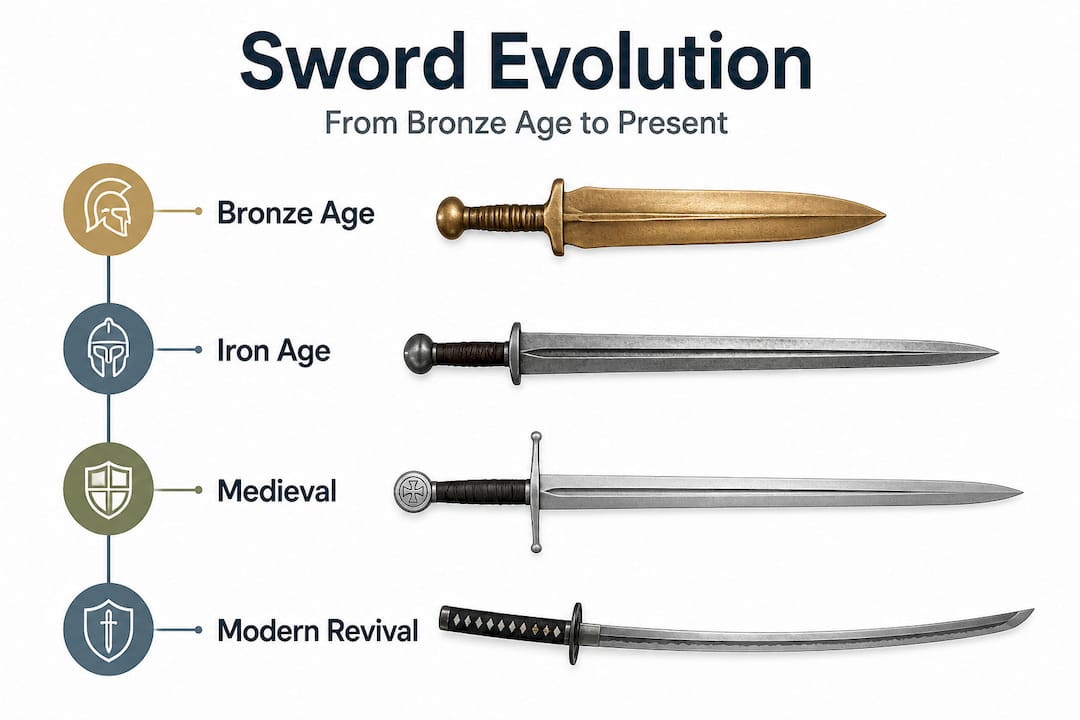
Pro Tip: When studying historical blades, pay attention to the cross-guard and pommel as much as the blade itself. These elements were not just functional; they were often personalized to the owner’s identity, family crest, or religious belief.
The medieval period also saw the codification of sword types: the arming sword, the longsword, the falchion, the estoc. Each was engineered for a specific type of opponent and armor. This diversity tells us something important: swords were adaptive tools, always evolving to meet the demands of the moment. You can explore the full range of this variety in our medieval swords collection, which captures many of these distinct forms.
The evolution of sword technology gave rise to deeper cultural meanings that extended far beyond combat. A sword was never just a weapon. It was a statement.
Archaeological evidence makes this undeniable. In early medieval graves across northern Europe, swords have been found carefully positioned alongside bodies, sometimes oriented to align with the spine, sometimes placed as if the deceased still gripped the hilt. Research on burial practices shows that swords in graves were intimately connected to elite masculinity and personhood, not merely prestige goods tossed in with other valuables but genuine extensions of the individual’s identity.
“The sword is not simply placed with the dead. It is placed as part of the dead, intertwined with the body in ways that suggest the weapon and the warrior were understood as inseparable.” — Archaeological analysis of early medieval burial contexts
This concept echoes across dozens of cultures. In feudal Japan, a samurai’s daisho (the paired long and short swords) was considered the physical embodiment of his soul. Losing or damaging a sword was not just a material loss; it was a spiritual wound. In ancient Rome, the right to carry a gladius marked citizenship and military service. In medieval Europe, the ceremony of dubbing a knight involved the sword at nearly every stage, from the vigil where the blade lay on the altar to the moment it touched the shoulder.
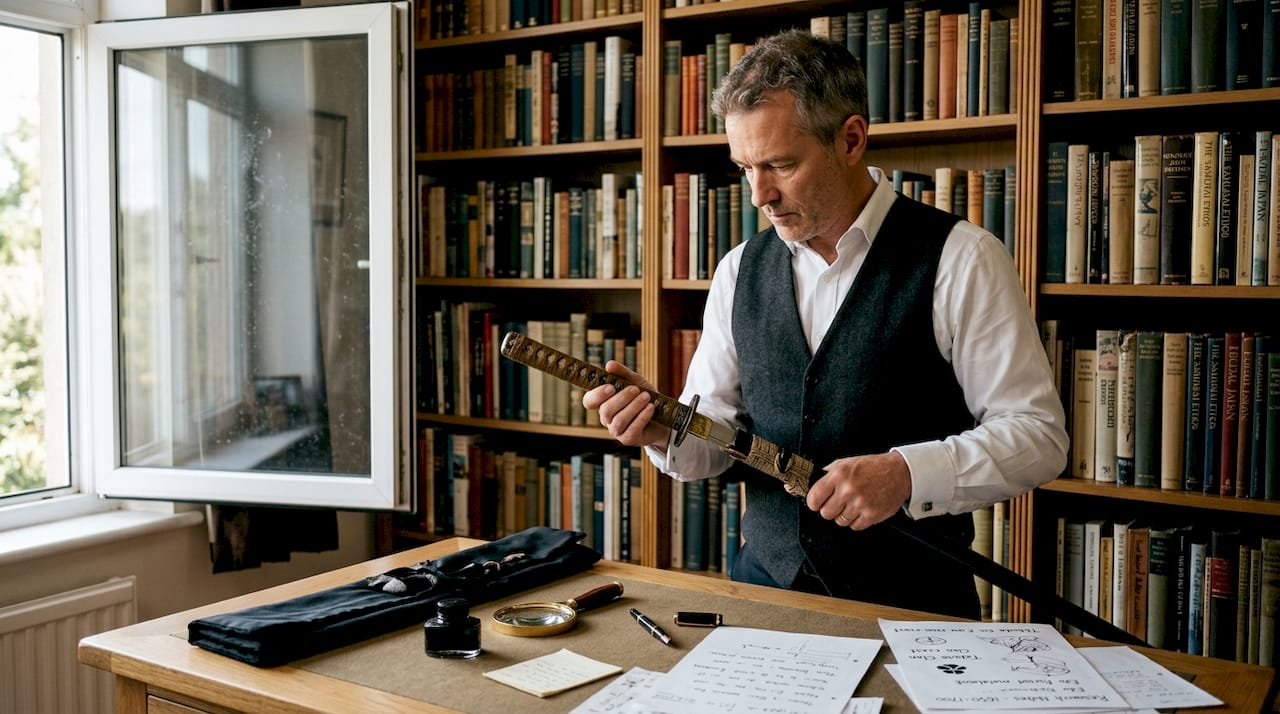
Swords also reinforced hierarchy in ways that are easy to overlook. Many legal codes in medieval Europe explicitly restricted sword carrying to certain classes. Peasants and commoners were often forbidden from wearing swords in public. The sword was not just a sign of status; it was legally protected as one. Understanding why people collect swords today often starts with this deep historical association between the blade and personal identity.
A quick look at how swords carried symbolic weight across cultures:
One persistent myth worth addressing: the idea that all great historical swords were produced through elaborate folding techniques, particularly Japanese blades. Experts in historical metallurgy have pointed out that folding myths often outpace the actual historical evidence. Some folding occurred to work out impurities in iron, but the mystical thousand-fold folding narratives popular in modern retellings are largely embellishments. The best blades were great because of skilled smiths, good materials, and precise heat treatment, not folklore.
For a deeper look at specific blades that changed history, the famous swords in history article covers individual weapons and the real stories behind them.
While swords carried cultural weight in daily life and ritual, their legendary status in stories reinforced their mystique through generations. Every culture with a sword tradition also has a legendary sword. These are not coincidences. They reflect how deeply people understood that the sword represented something larger than itself.
Consider the three most recognized legendary swords in Western and Eastern traditions:
| Legendary sword | Culture of origin | Core symbolism |
|---|---|---|
| Excalibur | British/Arthurian | Rightful sovereignty, divine appointment |
| Kusanagi no Tsurugi | Japanese | Imperial authority, heroic virtue |
| Durandal | French/Carolingian | Unbreakable faith, invincible warrior |
What is striking about these legends is not just the swords themselves but the terms in which they are described. Excalibur is not just sharp; it is impossible to wield without rightful kingship. Kusanagi was not just powerful; it was a gift from the gods, one of Japan’s three imperial treasures. Durandal, wielded by Roland, could not be broken or captured by enemies. In each case, the sword’s supernatural qualities mirror the moral or spiritual qualities its bearer was supposed to embody.
How did these legends develop? Consider the following pattern that appears across cultures:
This pattern is not accidental. Swords were durable in ways that cloth, wood, or food were not. A blade could outlive its owner by generations. That physical persistence made swords natural focal points for memory and continuity. The enduring sword legends we treasure today are the visible tip of a much deeper tradition of using blades to anchor collective identity.
Real artifacts reinforce these mythic connections. The Sword of Goujian, a Chinese bronze sword more than 2,400 years old, was found so well preserved that its edge was still razor sharp when archaeologists unwrapped it. The fact that such weapons survived astonishes us partly because we unconsciously recognize that mythology gave them reasons to survive: swords were never meant to be thrown away.
The narratives and traditions built around swords continue to resonate today, fueling a vibrant modern community. Sword collecting is not nostalgia for its own sake. It is a direct continuation of the same impulse that led medieval lords to commission elaborately decorated blades and samurai to treat their swords as living objects.
Modern collectors are motivated by a range of powerful, overlapping interests:
Historical reenactment groups play a huge role in keeping sword traditions alive. Organizations like the Society for Creative Anachronism, HEMA (Historical European Martial Arts) clubs, and Japanese koryu martial arts schools train with period-accurate weapons. They are not just playing dress-up; they are recovering actual fighting techniques from historical manuals, some of which had not been practiced in centuries. Their work has directly influenced the quality standards that modern sword makers now follow.
Pro Tip: If you are buying a sword for display or light handling, focus on the steel type and heat treatment. A blade with a proper hamon (the visible temper line in Japanese swords) or a well-profiled distal taper (gradual narrowing toward the tip in European swords) signals genuine craftsmanship, not just surface aesthetics.
For those ready to start or expand a collection, the sword collecting insights resource covers motivations and what to look for. Practical guidance on selecting quality pieces is available in the buying medieval swords guide, and for a structured starting point, the collectible swords checklist is an invaluable reference.
Here is the uncomfortable truth about mainstream sword history: almost every popular account focuses on combat above everything else. Battle stats, kill counts, tactical innovations. That framing misses roughly half of what swords actually meant to the people who made and carried them.
The social and symbolic dimensions of swords were not secondary to their military function. In many periods and cultures, they were primary. A lord’s sword was more important at his investiture ceremony than it ever was on the battlefield. A samurai’s sword was more important as a daily marker of class and soul than it was in actual combat, which relatively few samurai ever experienced. The sword as weapon was the foundation; the sword as symbol was the living structure built on top of it.
We also see persistent myths treated as history, particularly around sword making. The obsession with folding myths in popular culture is a perfect example. These stories are compelling because they make the blade feel magical, imbued with ritual. The reality, that great swords came from skilled smiths working with good iron and precise temperature control, is somehow less satisfying to modern audiences. But that reality is actually more impressive. It required generations of accumulated technical knowledge, not mysticism.
What we believe, based on years of working with collectors and studying historical accounts, is that the most honest and rewarding way to engage with swords is to see them as living links between past and present. Not frozen museum objects. Not fantasy props. Objects that carried real weight in real lives, and that still carry that weight for people who understand their full story. That is the spirit behind every piece featured in our deep dive into sword collecting content: honoring both the history and the passion.
For those inspired by the role and legacy of swords, exploring or owning a piece of history can be a fulfilling pursuit. Whether you are drawn to the knightly traditions of medieval Europe, the refined elegance of Japanese sword culture, or the legendary blades of mythology and screen, there is a remarkable blade waiting for you.
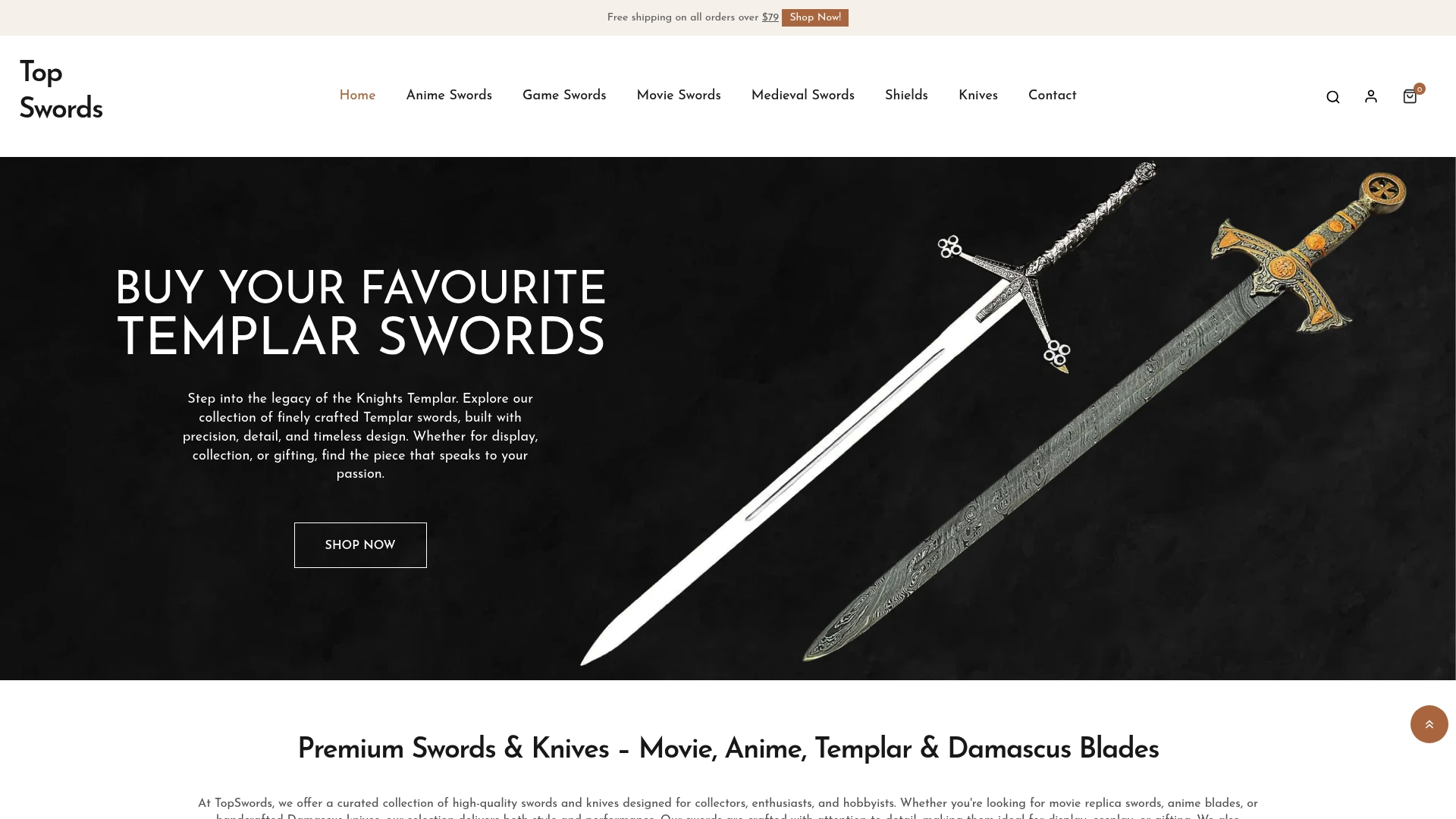
At TopSwords, every piece in our catalog is chosen with both authenticity and craftsmanship in mind. We offer hand-forged Damascus steel swords, detailed medieval replicas, and iconic blades from film and legend, all built to meet the standards that serious collectors expect. Each sword tells a story. Our job is to make sure the blade in your hands is worthy of that story. Browse our collections today and find the sword that connects with your own sense of history and identity.
Swords first appeared during the Bronze Age, around 3300 BCE, as short bronze blades, gradually developing into longer and more durable iron weapons by the early Iron Age.
Archaeological research shows that swords in elite graves were intimately tied to identity and personhood, functioning as extensions of the deceased rather than simple status goods.
No, swords served as symbols of legal authority, spiritual power, social class, and ritual ceremony across dozens of cultures, often far more than they saw actual battlefield use.
Experts actively debate sword folding myths; while some folding occurred to remove impurities, the elaborate thousand-fold techniques popular in modern stories are largely embellishments without strong historical backing.
Collectors prize swords for their craftsmanship, historical depth, connection to legendary figures and events, and as tangible links to traditions of identity and heritage that span thousands of years.
{"one"=>"Select 2 or 3 items to compare", "other"=>"{{ count }} of 3 items selected"}