
VISIT OUR ONLINE SHOP
Available 24/7 via chat
Available 24/7 via chat
Available 24/7 via chat
Available 24/7 via chat

Every serious practitioner has had that moment. You’re at a HEMA event, a cosplay showcase, or a reenactment rehearsal, and someone draws too fast, sweeps the blade wide, and the tip catches a partner’s forearm or shatters a display case. It takes less than a second. Even experienced martial artists make these mistakes, and the consequences range from embarrassing to genuinely dangerous. Safe sword handling isn’t a beginner’s concern. It’s a discipline that every martial artist, historical reenactor, and cosplayer needs to practice deliberately, with structured methods and the right equipment. This guide delivers exactly that.
| Point | Details |
|---|---|
| Choose safer swords | Select blunted, flexible, or rounded-tip swords to minimize risk during practice and events. |
| Prepare your space | Set up a clear, well-lit area and wear recommended protective gear for every sword activity. |
| Follow strict handling steps | Use proper grip, drawing, and carrying techniques to prevent accidents. |
| Enforce mutual checks | Establish structured safety checks and rules to catch mistakes early. |
| Adopt a safety mindset | True sword safety starts with respecting hazards and environment before picking up a blade. |
Understanding what makes a sword dangerous is the first practical step before you ever pick one up. Swords present three core hazards: sharp edges, rigid tips, and unpredictable balance. A blade with a poorly fitted guard can shift during movement, throwing off your control. A rigid tip with no flex can penetrate inadequate protective gear during sparring. And even a “display only” blade with a ground edge can inflict a serious cut if handled carelessly.
The HEMA hierarchy of control makes a critical point that many practitioners overlook: safer sword choices should come before relying on protective equipment. In other words, choosing the right type of sword for your activity is itself a primary safety control, not an afterthought.
Here’s a breakdown of common sword types and their relative safety features:
| Sword type | Edge | Tip | Flex | Best use |
|---|---|---|---|---|
| Polypropylene practice sword | None | Rounded | High | Sparring, drills, beginner training |
| Steel blunted trainer | Blunt | Rounded | Low to medium | Controlled sparring, HEMA drills |
| Functional battle sword | Sharp | Pointed | Low | Display, cutting practice, reenactment |
| Decorative replica | Variable | Variable | Very low | Display, cosplay, collection |
| Stage combat sword | Blunt | Rounded | Medium | Choreography, theater |
When selecting a sword for practice or cosplay, prioritize these features:
For collectors and reenactors who want authentic aesthetics without compromising safety, medieval swords built on historical designs can offer the look of a period blade with modern construction standards. If you’re just starting sparring drills, a training sword sparring equipment built from polypropylene gives you realistic handling without the injury risk of steel.
Pro Tip: Before every session, run your thumb along the blade’s flat (never the edge) and inspect all fittings. Microcracks in blades and loose guards are silent hazards that cause accidents in the middle of drills. A battle sword with leather sheath stored properly in its sheath is far safer than one left exposed on a rack.
Choosing safer equipment gets you halfway there. The other half is your environment and what you’re wearing when you handle the sword. Even a blunted practice weapon can cause real injury if you’re swinging it in a cramped room with poor lighting and no protective gear.
A safe practice or performance space requires four things. First, clear space. You need a minimum radius of your arm span plus the sword’s full length in every direction before you swing. Second, non-slip flooring. Stumbling during a draw or drill is one of the fastest ways to cause a self-inflicted injury. Third, controlled lighting that eliminates shadows and blind spots. Fourth, restricted access during live sparring or drills. No spectators wandering into range.
Safety note: For HEMA sparring with steel trainers, a minimum 800N rated fencing jacket and certified steel mesh gloves are non-negotiable. These ratings mean the material can withstand 800 newtons of thrust force, which is the baseline for safe sparring contact. Anything below this standard increases injury risk significantly.
The HEMA hierarchy of control categorizes PPE as the last layer of protection, applied only after you’ve already eliminated hazards through equipment choice and administrative controls. That’s an important mindset shift. PPE isn’t your primary shield. It’s your backup.
Here’s a practical PPE reference by activity:
| Activity | Gloves | Mask/Helmet | Jacket | Eye protection |
|---|---|---|---|---|
| Sparring (steel) | Steel mesh, 800N rated | Full fencing mask | 800N rated jacket | Included in mask |
| Sparring (polypropylene) | Light padded gloves | Fencing mask | Padded jacket | Optional |
| Display/reenactment | Optional | Not required | Period costume | Optional |
| Cosplay handling | Light gloves recommended | Not required | Not required | Not required |
| Cutting practice | Cut-resistant gloves | Eye protection | Heavy apron | Safety glasses |
For practitioners working with heavier, functional blades like a damascus battle sword or a battle ready sword, appropriate gloves and eye protection are strongly recommended even outside of sparring contexts, especially during cleaning, sharpening, or transport.
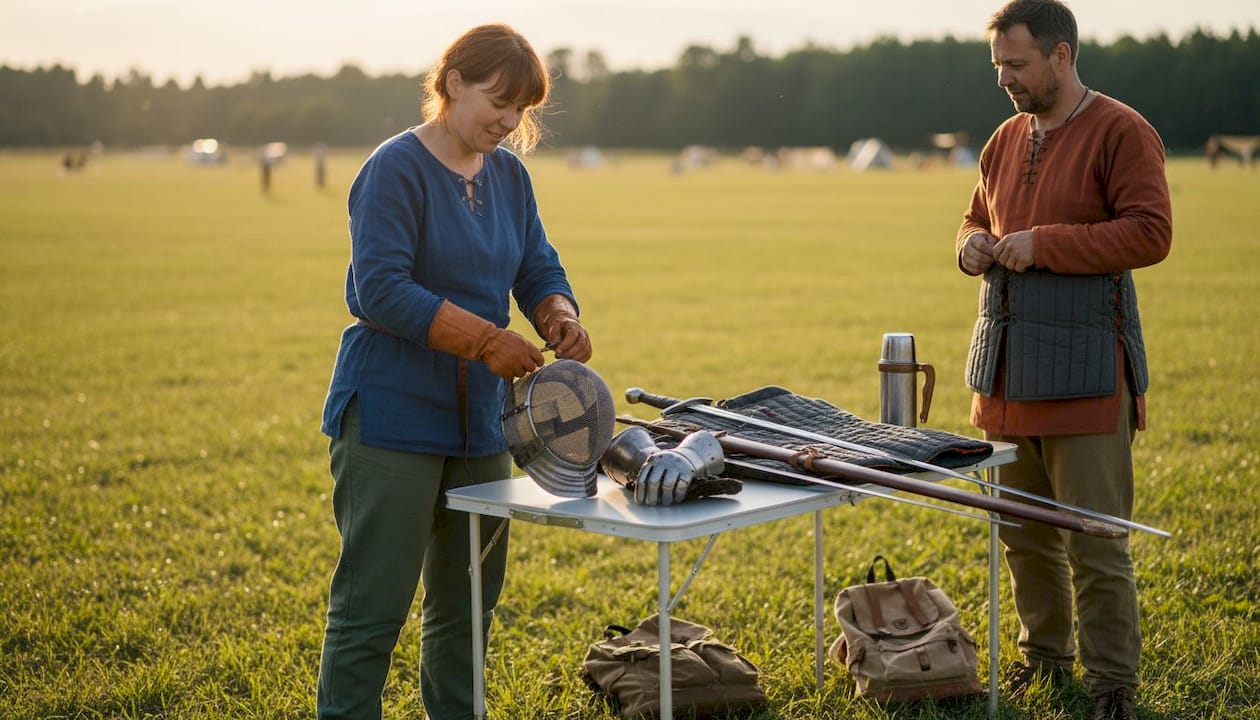
Correct technique is where all the preparation pays off. Even with the right sword and the right gear in the right environment, poor handling technique is what causes accidents. The following steps cover the core handling sequence for any scenario, from a display hall to a sparring session.
1. Grip the sword correctly. Wrap your dominant hand around the grip with fingers closed, thumb aligned along the side. Your grip should be firm but not white-knuckled. A death grip causes fatigue and reduces fine motor control during extended handling.
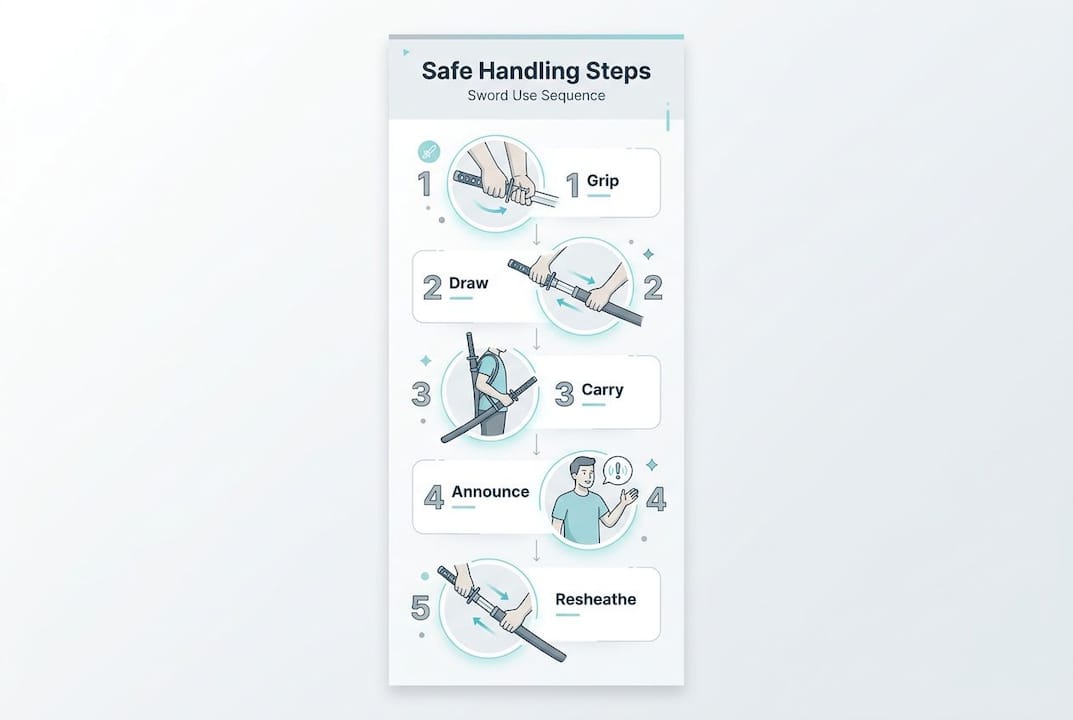
2. Draw from the sheath with intention. Pull the blade straight out in the direction of the sheath’s opening. Never torque the blade against the mouth of the sheath, which can stress the fittings. With a longsword or two-handed sword, use the off hand to stabilize the sheath during the draw.
3. Establish a safe carry position. Once drawn, position the blade either pointed directly upward with the flat facing outward, or pointed downward at your side. Never carry a drawn sword horizontally at hip level in any populated space. The downward carry is the safest default when moving through a venue or event space.
4. Announce your intentions during group drills. Before executing any technique with a partner, verbally confirm the movement. “Ready.” “Stepping right.” “Bind.” These short calls prevent both partners from moving at the same time in conflicting directions.
5. Display the sword securely. When placing a sword on a stand or display surface, position it horizontally with the edge facing away from foot traffic. Always use a sheath or blade cover for unattended display pieces.
6. Resheathe with care. Return the blade to its sheath slowly, guiding the tip with your off hand in a controlled motion. Never resheathe quickly. Speed here has no benefit and creates a major laceration risk.
The HEMA hierarchy of control frames discipline through structured methods as a core safety layer. Following this sequence isn’t just procedural. It’s what separates controlled practice from reckless handling. Whether you’re working with a historical replica sword or a gladiator sword, the handling sequence stays the same.
Pro Tip: Run every technique at 25% speed before adding power or choreography. Speed exposes technique flaws at the worst possible moment. Slow practice builds the muscle memory that keeps you and everyone around you safe when things speed up.
Technique and preparation only protect you if you consistently verify them. This is where mutual safety checks come in, and it’s the step most practitioners skip when they’re eager to get into a drill or onto a stage.
A mutual safety check is a structured moment before any sparring, choreography, or group handling session where both parties confirm readiness. This includes verifying that both practitioners are wearing appropriate PPE, that grip and stance are correct, that the practice space is clear, and that both parties understand and agree to the session’s protocol.
Structured mutual checks are documented to reduce unsafe behavior in group sword training contexts. When clubs formalize this process, injury rates drop because it removes the assumption that “the other person already checked.”
The core rules that apply across all contexts:
Here are the most frequent mistakes practitioners make, and the fixes:
Even heavier, more dramatic pieces like a broadsword claymore require the same level of discipline. The size of the weapon doesn’t change the protocol. It makes it more critical.
Here’s the uncomfortable truth that most safety guides avoid: the biggest risk factor in sword handling isn’t the sword itself. It’s the mindset of the person holding it.
Seasoned practitioners will often focus on technique, gear ratings, and choreography precision. Those matter. But the majority of preventable accidents happen before the sword even leaves the sheath. They happen because someone didn’t take the environment seriously, because a display piece got picked up impulsively, or because the group skipped the pre-session mutual check because “everyone already knows the drill.”
The HEMA hierarchy of control gets this right. Eliminate the hazard first. Engineer the environment second. Set administrative rules third. Use PPE last. This order exists because each layer compensates for the one above it failing. If you’ve eliminated the hazard properly, you need less PPE. If your environment is controlled, your technique can be more relaxed. The layers build on each other.
What this means practically is that safety is a decision you make before you touch the sword. It’s in how you store it, how you set up the space, and how you communicate with everyone else in the room. Even cosplayers and collectors need to internalize this. A decorative piece hanging on a wall is not a prop waiting to be picked up impulsively. It carries real weight, real edges, and real consequences.
Respect the lineage of the object. Real swords, including the finest pieces in any medieval sword collection, were designed to incapacitate. That context should inform every decision you make around them.
At Top Swords, we source and craft blades specifically for the martial arts, reenactment, and cosplay communities. We understand that your needs are specific. You’re not looking for a prop. You’re looking for craftsmanship, historical accuracy, and the right level of safety for your activity.

Whether you’re equipping a sparring practice with a reliable training sword practice equipment, adding an authentic functional piece like a handmade battle sword to your collection, or searching for the right historical design to complete your reenactment kit, Top Swords has blades built to the standard that serious practitioners expect. Take a moment to browse medieval swords and explore our full catalog of handcrafted pieces, training equipment, and display swords. Each product listing includes detailed specifications to help you match the right sword to your exact activity and safety needs.
Look for blunted edges, flexible blades, rounded tips, and secure fittings; the HEMA safety hierarchy confirms that safer equipment is the first line of defense before any protective gear.
For cosplay, replica swords with blunted edges and lightweight materials are the safest choice; safer sword choices should always come first, especially in public or crowded event settings.
Unsheathing or swinging a sword in an uncontrolled setting is the top mistake; structured handling methods and mutual checks are the most effective way to prevent this.
PPE is most critical for sparring or handling heavier functional blades; the HEMA control hierarchy positions it as the last layer of protection, after hazard elimination and environment control.
Yes: follow event rules that prohibit unsheathing outside designated areas, always keep your blade sheathed during transit through crowds, and maintain clear space around yourself whenever a sword is drawn.
{"one"=>"Select 2 or 3 items to compare", "other"=>"{{ count }} of 3 items selected"}